
You’ve spent months writing posts and submitting each beneath a class or two. A number of tags right here, a couple of tags there.
Then you definitely open Google Search Console and discover dozens of class and tag archives in your index. Some have one put up. Some are near-duplicates of one another. None of them rank on serps.
That occurs as a result of WordPress creates a public archive web page for each class and tag you add, and by default these pages are only a record of put up excerpts with no distinctive content material. A class web page might be one of many strongest pages in your web site, or one of many weakest, relying on the way you set it up.
On this put up I’ll clarify how class and tag pages have an effect on Search engine optimization, when to index or noindex them, and learn how to optimize WordPress class and tag pages utilizing WordPress and Rank Math.
Key Takeaways:
- WordPress classes are hierarchical groupings meant for broad subjects, whereas WordPress tags are flat labels meant for particular particulars, and the 2 needs to be optimized in a different way.
- Class pages can rank for broad, aggressive key phrases once they embrace a singular introduction, a customized Search engine optimization title, and robust inside hyperlinks.
- Tag pages typically create skinny or duplicate content material, so most websites ought to both noindex them or hold solely a small, curated set listed.
- Rank Math Search engine optimization permits you to set titles, meta descriptions, robots meta, and sitemap inclusion for class and tag archives from Rank Math Search engine optimization → Titles & Meta.
- Empty or near-empty archives waste crawl consideration and dilute web site high quality, which is why Rank Math features a setting to noindex empty class and tag archives routinely.
1 What Are WordPress Class and Tag Pages?
WordPress class and tag pages are archive pages that WordPress generates routinely to record each put up assigned to a given class or tag. Each are forms of taxonomies, WordPress’s time period for a system for grouping content material.
The 2 taxonomies serve totally different functions, as the next comparability exhibits:
| Classes | Tags | |
|---|---|---|
| Goal | Broad subjects (e.g., “WordPress Search engine optimization”) | Particular particulars (e.g., “Schema markup”) |
| Construction | Hierarchical (dad or mum and baby classes) | Flat (no hierarchy) |
| Required? | Sure, each put up wants at the least one | No, tags are non-obligatory |
| Default URL | instance.com/class/wordpress-seo/ | instance.com/tag/schema-markup/ |
| Typical Search engine optimization function | Matter hub that may rank | Navigation assist, often noindexed |
2 Why Class and Tag Pages Matter for Search engine optimization
Class and tag pages matter for SEO as a result of they form how serps perceive your web site’s subjects and the way hyperlink worth flows between your posts.
Nicely-built class pages help your Search engine optimization within the following methods:
- Topical authority: A class web page that teams 20 associated posts tells Google your web site covers that subject in depth.
- Broad key phrase focusing on: A class web page can rank for a head time period like “WordPress safety,” whereas the person posts inside it goal long-tail variations.
- Inner hyperlink distribution: Class pages hyperlink to each put up they comprise, which helps new posts get found and crawled quicker.
- Higher person navigation: Guests who land on a class web page can browse associated content material as an alternative of bouncing again to the search outcomes.
Poorly managed taxonomies trigger the alternative impact. Dozens of tag pages with one or two posts every create thin content, which implies pages with little distinctive worth. Overlapping tags equivalent to “Search engine optimization tip,” “Search engine optimization ideas,” and “Search engine optimization-tips” create duplicate content, as a result of every archive exhibits nearly the identical record of posts.
The connection works like this: too many low-value archives → diluted crawl consideration → weaker alerts about which pages matter. Because of this, your essential pages compete with your individual muddle.
3 Ought to You Index or Noindex Class and Tag Pages?
It’s best to index class pages which have sufficient posts and distinctive content material to be helpful on their very own, and noindex tag pages until they’re curated and substantial.
A noindex tag tells serps to not present a web page in search outcomes, whereas nonetheless letting them comply with the hyperlinks on that web page.
The fitting alternative relies on the kind of archive, as summarized beneath:
| Archive Sort | Advice | Motive |
|---|---|---|
| Foremost class pages with 5+ posts | Index | They will rank for broad subject key phrases |
| Classes with 0–2 posts | Noindex (or merge) | They’re skinny and provide little worth but |
| Most tag pages | Noindex | They often overlap with classes and one another |
| Curated tag pages with distinctive intros | Index selectively | They will work like mini subject hubs |
| WooCommerce product classes | Index | They’re core procuring touchdown pages |
Word: Noindexing a web page doesn’t take away it out of your web site. Readers can nonetheless use it to browse, and inside hyperlinks on the web page nonetheless go worth to your posts.
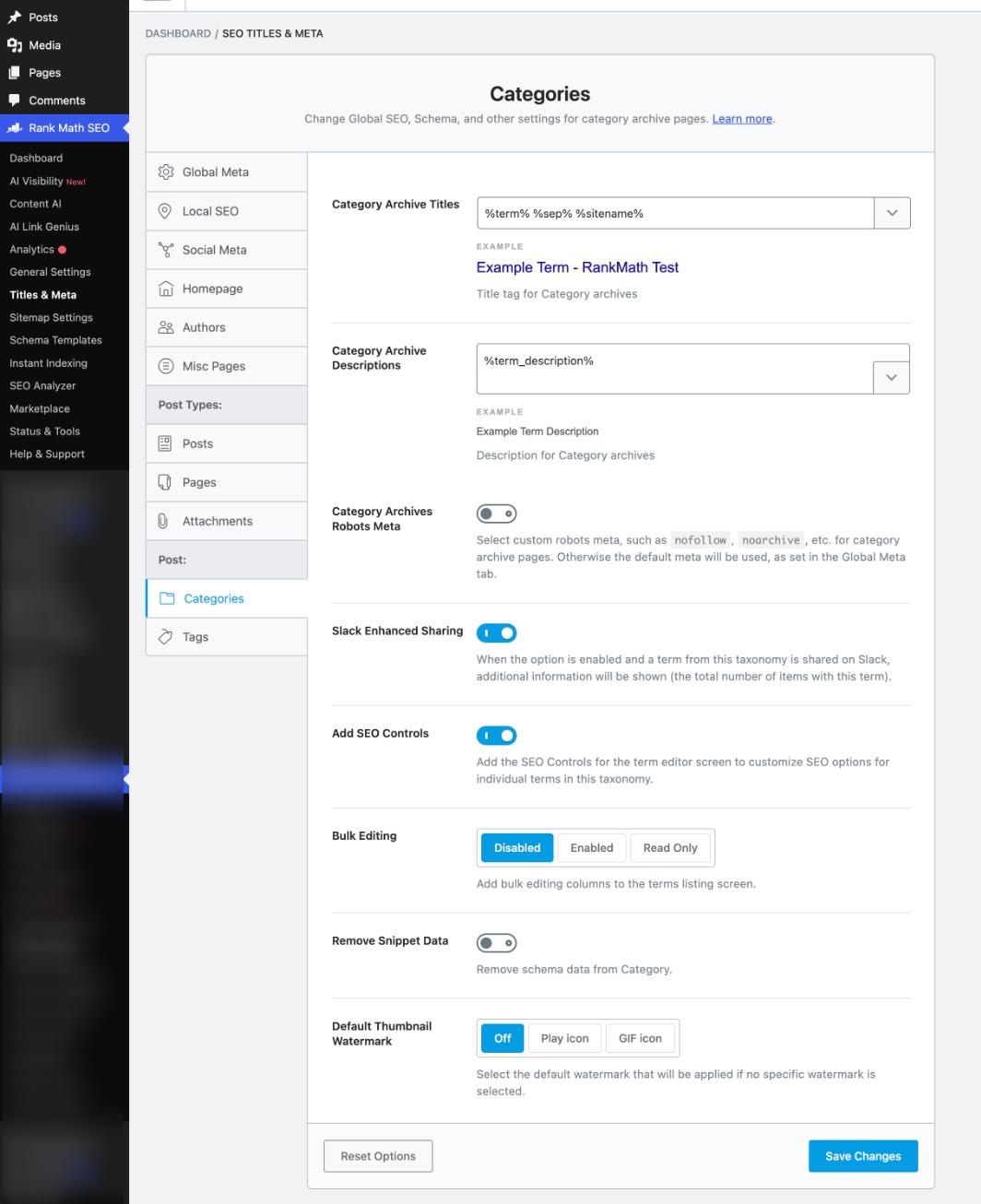
Rank Math permits you to set these guidelines globally.
To take action, navigate to Rank Math Search engine optimization → Titles & Meta → Classes (or Tags) and modify the robots meta for that taxonomy.
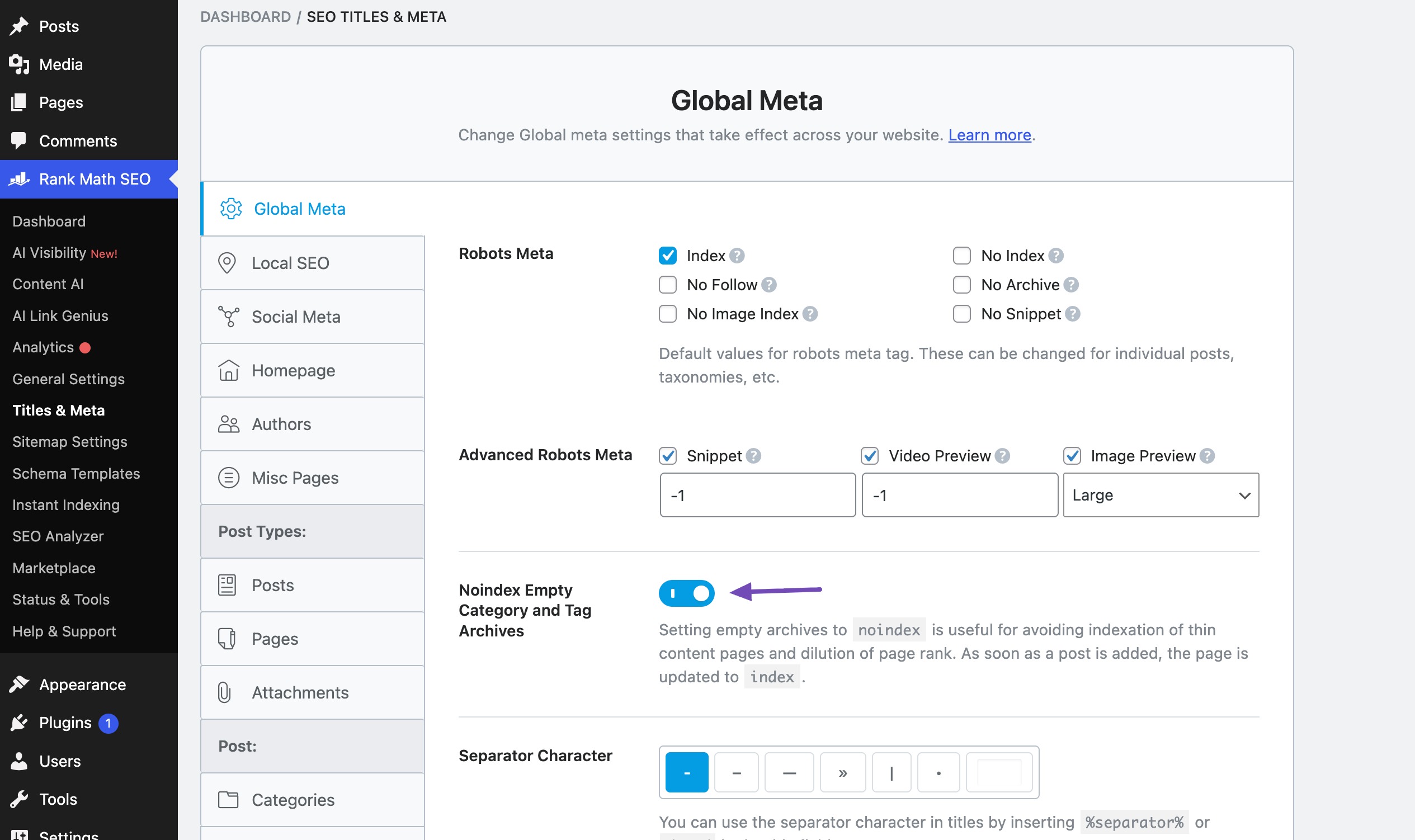
To deal with empty archives routinely, navigate to Rank Math Search engine optimization → Titles & Meta → World Meta and allow Noindex Empty Class and Tag Archives, which retains archives with no posts out of the index.
It’s also possible to override the worldwide rule on a single class or tag from its edit display, which is beneficial when one tag deserves to rank whereas the remainder keep noindexed.
4 How you can Optimize WordPress Class Pages
Optimizing a WordPress class web page means turning an auto-generated record of posts right into a touchdown web page with a transparent subject, distinctive content material, and a robust inside hyperlink construction.
4.1 Plan a Clear Class Construction
A clear class construction is a brief record of broad, non-overlapping classes that displays the primary subjects of your web site. Most blogs work properly with 5 to 10 top-level classes, with baby classes solely the place a subject is massive sufficient to separate.
Use these guidelines when planning or cleansing up classes:
- Give every class a definite subject that doesn’t overlap with one other class.
- Assign every put up to at least one major class at any time when potential.
- Merge classes with just one or two posts right into a associated dad or mum class.
- Take away or rename the default “Uncategorized” class so it doesn’t seem in search.
This issues as a result of each class you create turns into a public URL. Fewer, stronger classes give every archive sufficient content material to deserve a spot in search outcomes.
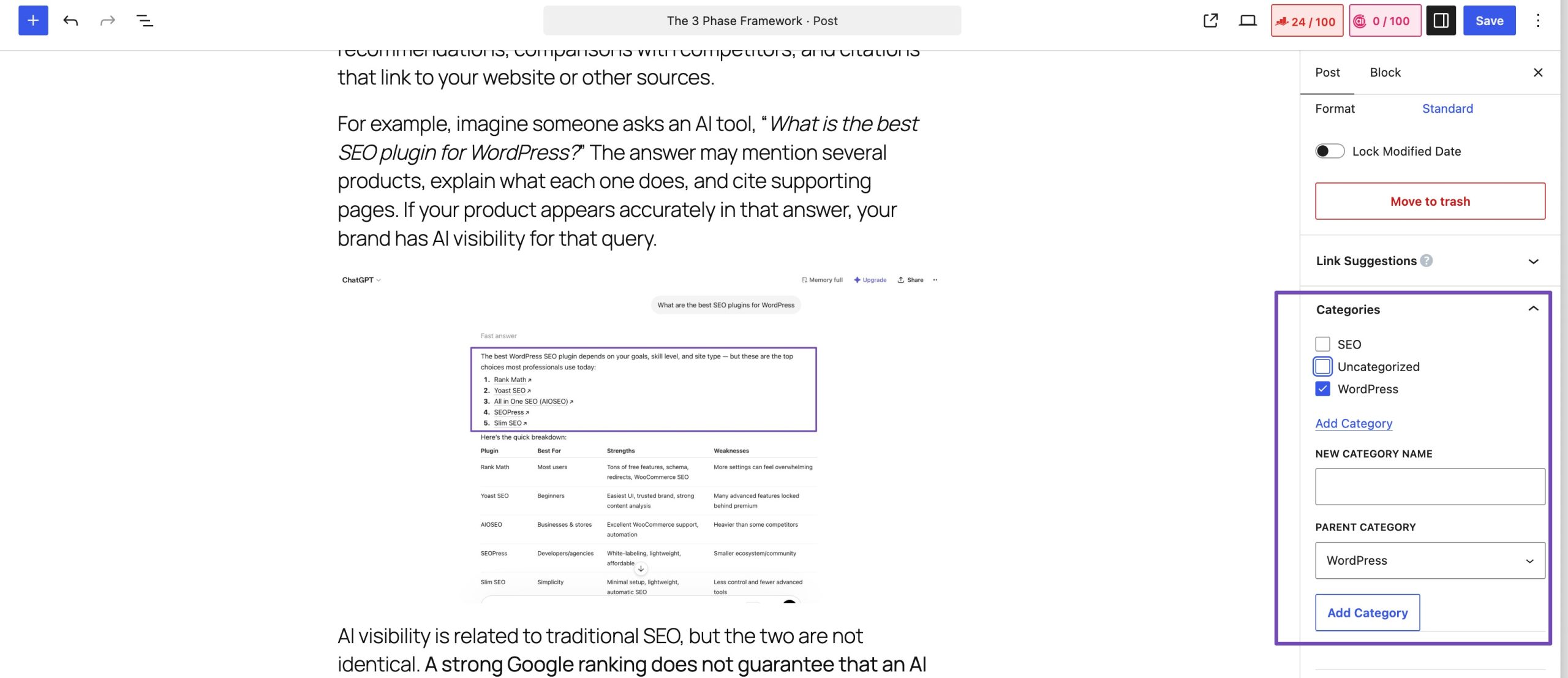
If a put up belongs in multiple class, Rank Math permits you to set a major class, which controls which class seems in breadcrumbs and sure URL buildings.
4.2 Write a Distinctive Class Description
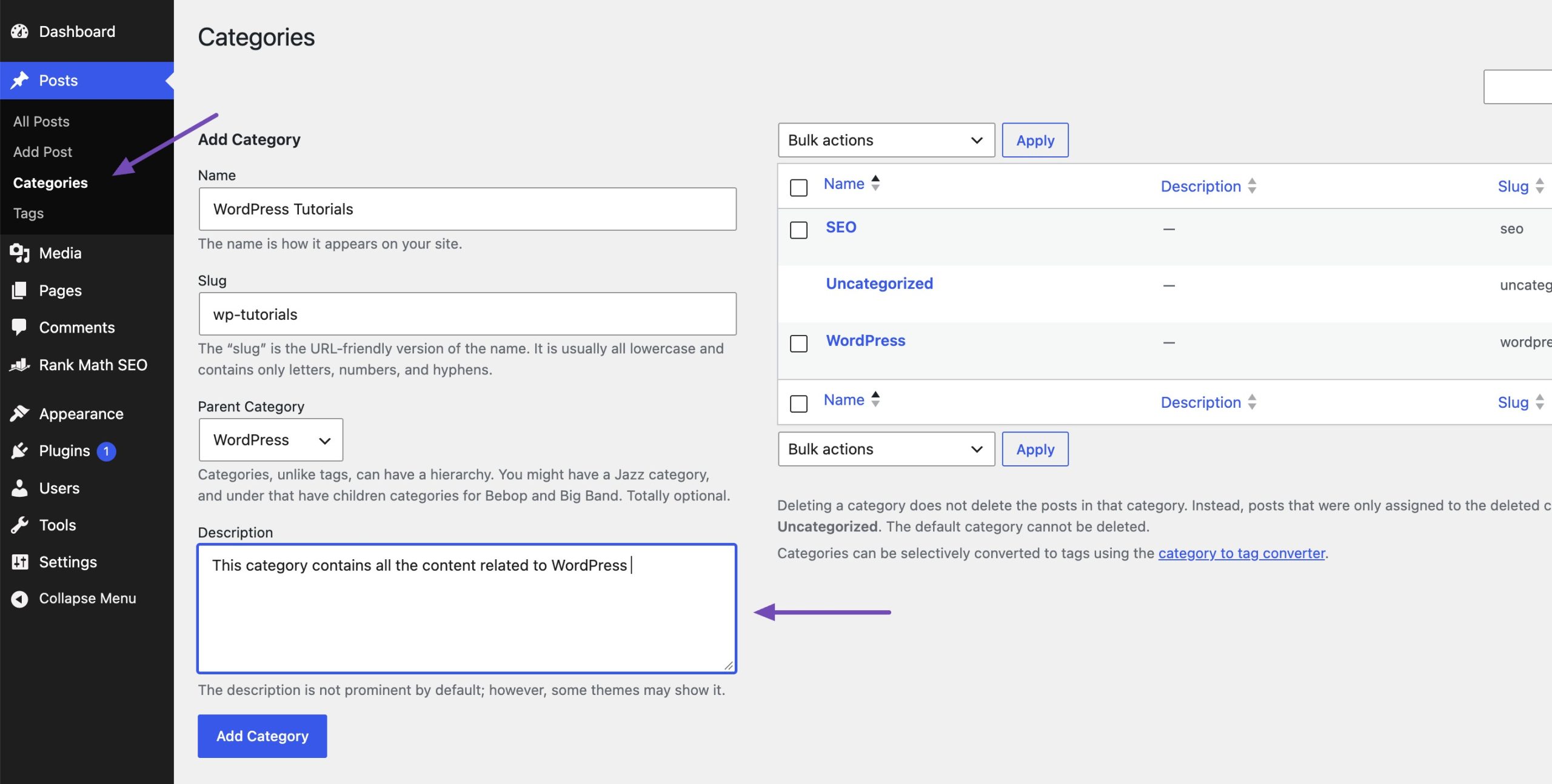
A class description is the introductory textual content that seems on the prime of a class archive, and it’s the single largest improve you can also make to a class web page. With out it, the web page has no content material of its personal, solely excerpts borrowed from different posts.
So as to add an outline, go to Posts → Classes, click on Edit beneath the class, and fill within the Description subject.
A powerful class description consists of the next components:
- A primary sentence that defines the subject and makes use of the class’s most important key phrase naturally.
- Two or three paragraphs explaining what readers will discover and who it’s for.
- Hyperlinks to your two or three greatest “begin right here” posts within the class.
- Non-compulsory: a brief FAQ or a listing of subtopics for bigger classes.
Word: Some themes don’t show the class description on the entrance finish. In the event you add an outline and don’t see it on the archive, examine your theme’s archive template or settings, as a result of serps can solely reward content material that’s truly on the web page.
4.3 Set a Customized Search engine optimization Title and Meta Description
A customized Search engine optimization title and meta description management how your class web page seems in Google’s search outcomes, which straight impacts click-through price.
WordPress’s default class title is usually simply the class title plus your web site title, which doesn’t inform searchers why they need to click on.
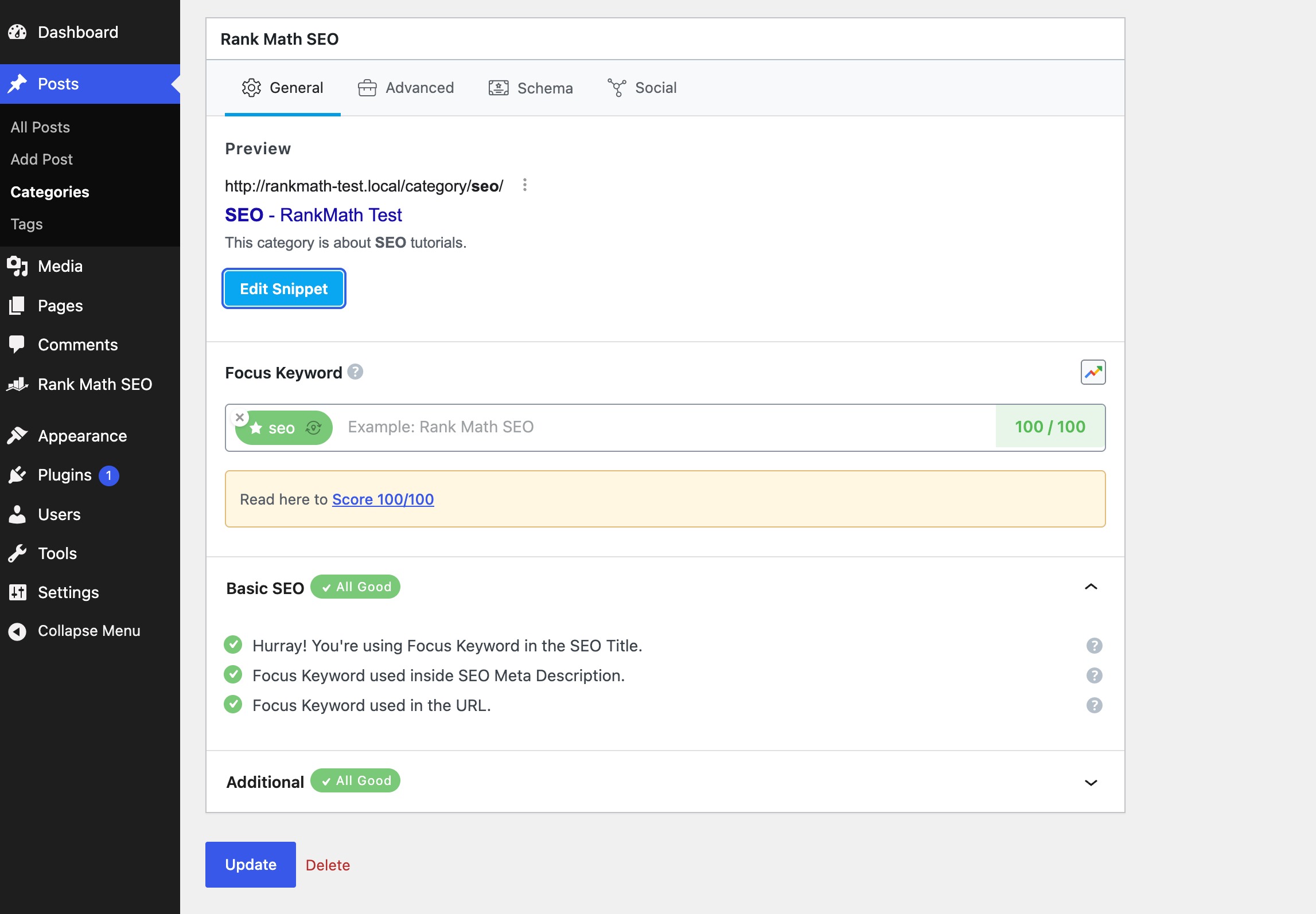
Rank Math offers you two methods to set these:
- Globally: Go to Rank Math Search engine optimization → Titles & Meta → Classes and set the default archive title and outline utilizing variables equivalent to
%time period%and%sitename%. - Per class: Open any class beneath Posts → Classes → Edit and scroll to the Rank Math meta field to jot down a customized Search engine optimization title, meta description, and focus key phrase.
4.4 Clear Up Class URLs
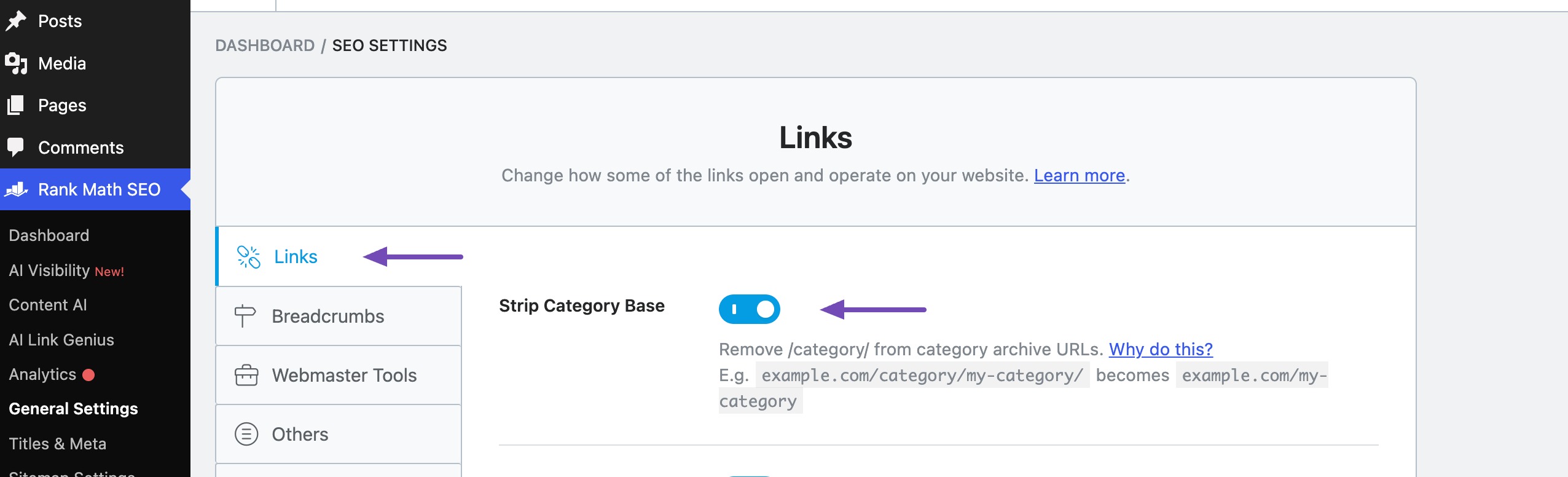
A clear class URL is brief, readable, and freed from pointless phrases. By default, WordPress provides /class/ to each class URL, equivalent to instance.com/class/wordpress-seo/.
Rank Math can take away that base with the Strip Class Base possibility beneath Rank Math Search engine optimization → Normal Settings → Hyperlinks, which turns the URL into instance.com/wordpress-seo/. Rank Math additionally handles the redirect from the outdated URL so current hyperlinks hold working.
Word: Altering URLs on a longtime web site impacts each class hyperlink directly. Make the change throughout a quiet interval, then examine Google Search Console for crawl errors over the next weeks.
4.5 Add Inner Hyperlinks and Breadcrumbs
Inner hyperlinks and breadcrumbs assist serps perceive the place a class web page sits in your web site’s hierarchy and the way essential it’s.
A class web page that solely seems in your sidebar receives far much less inside hyperlink worth than one which’s linked out of your posts and navigation.
With Rank Math, now you can add internal links with the assistance of AI.
You may strengthen a class web page’s inside hyperlinks within the following methods:
- Add your most important classes to your web site’s major navigation menu.
- Hyperlink to the related class web page from inside your posts if you point out the subject.
- Hyperlink from the class description to your greatest posts, so hyperlink worth flows in each instructions.
- Allow breadcrumbs so each put up hyperlinks again to its class routinely.
To enable breadcrumbs in Rank Math, navigate to Rank Math Search engine optimization → Normal Settings → Breadcrumbs, as proven beneath.
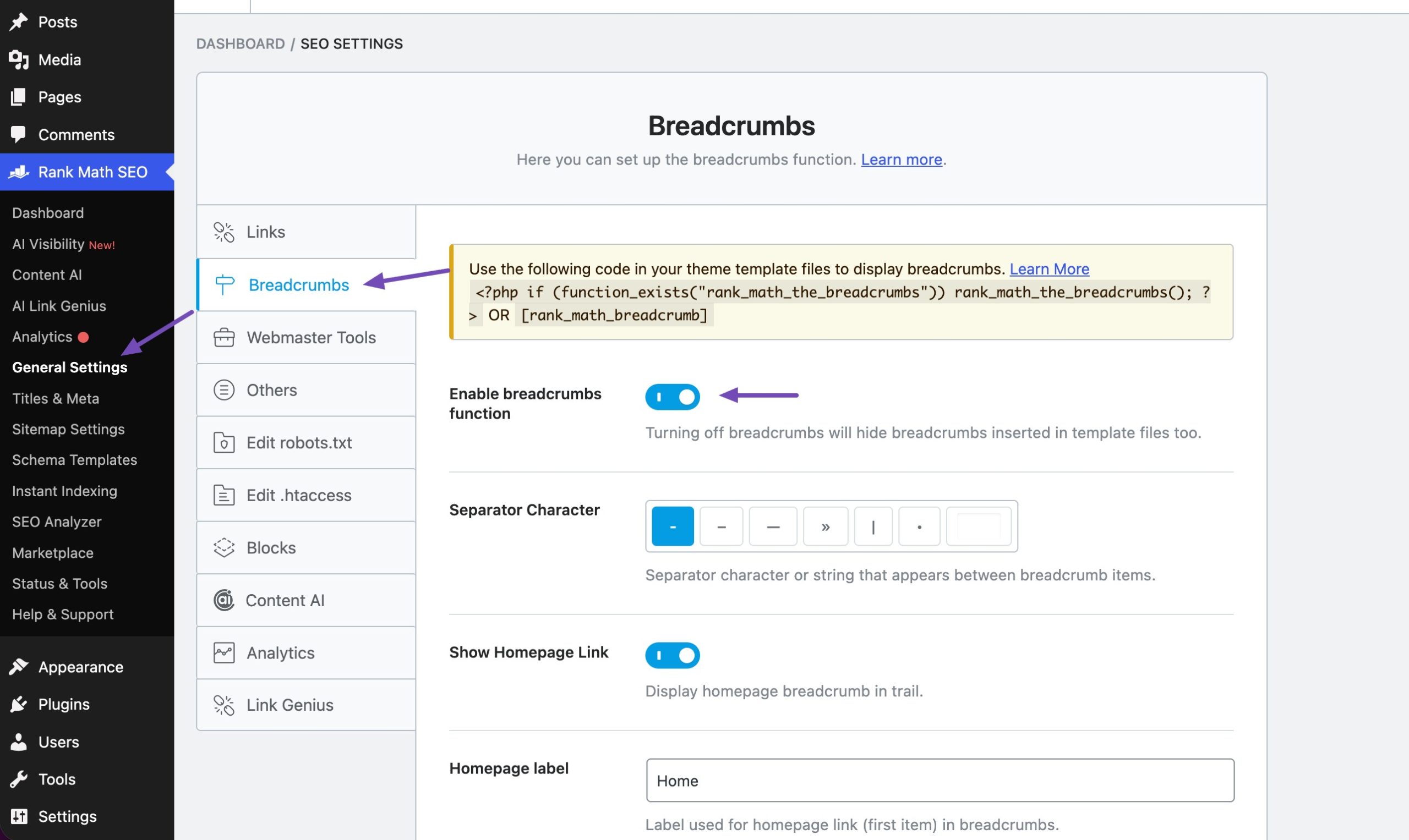
Rank Math additionally provides BreadcrumbList Schema, which will help Google show your web site hierarchy in search outcomes as an alternative of a uncooked URL.
4.6 Embody Class Pages in Your Sitemap
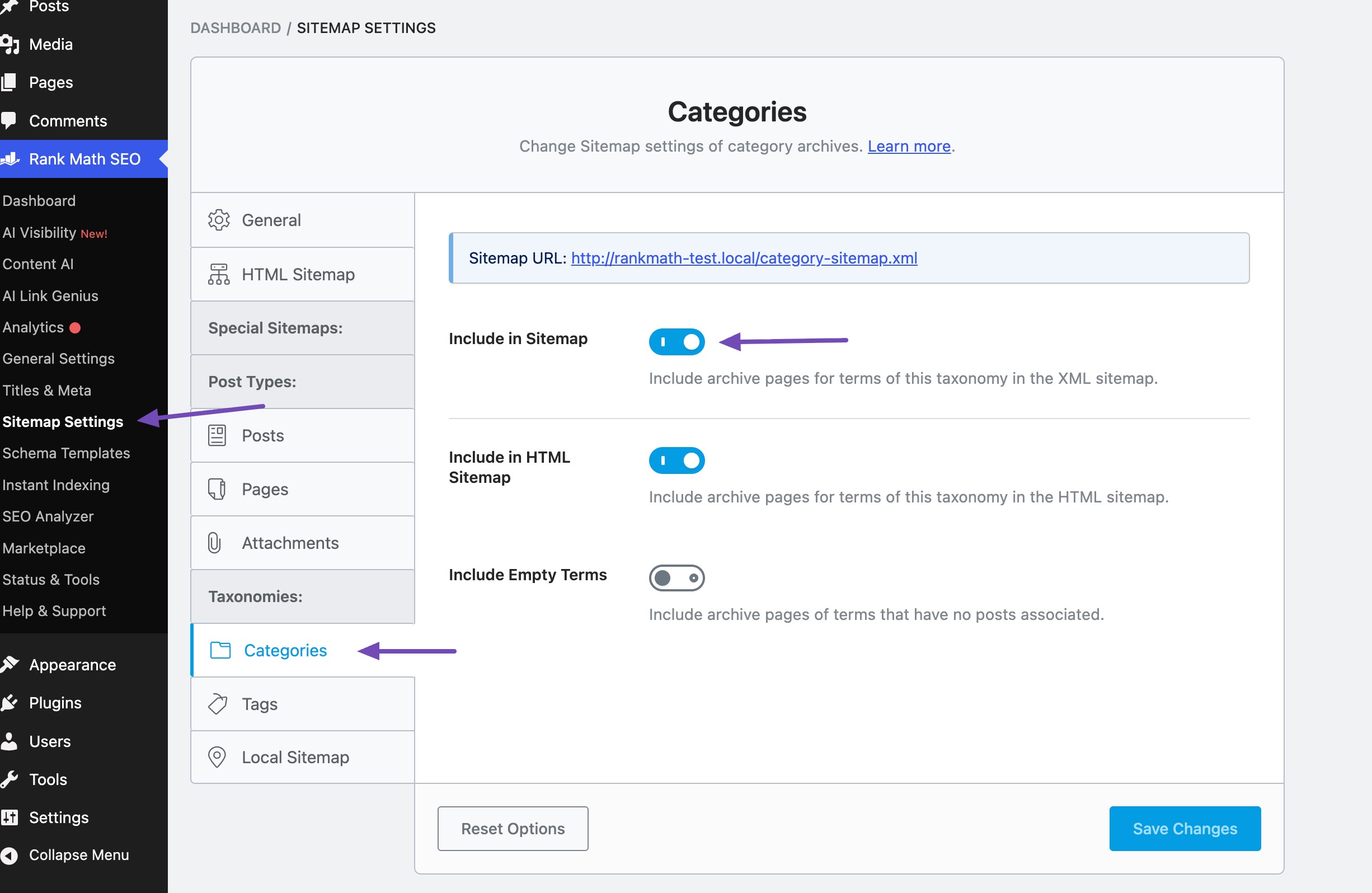
Your XML sitemap is the record of URLs you’re asking serps to crawl, so it ought to embrace indexable class pages and exclude noindexed ones.
Itemizing a noindexed web page in your sitemap sends combined alerts: you’re asking Google to crawl a web page whereas telling it to not index that web page.
To manage this in Rank Math, go to Rank Math Search engine optimization → Sitemap Settings, open the Classes and Tags tabs, and toggle Embody in Sitemap to match your indexing choices.
5 How you can Optimize WordPress Tag Pages
Optimizing WordPress tag pages largely means controlling them: limiting what number of you create, stopping duplicates, and deciding which few, if any, should be listed.
Tags are helpful for readers, however their flat, limitless construction makes them the most typical supply of skinny archives on WordPress websites.
Comply with these steps to carry tag pages beneath management:
Audit your current tags. Go to Posts → Tags out of your WordPress dashboard and kind by the Depend column to seek out tags with just one or two posts.
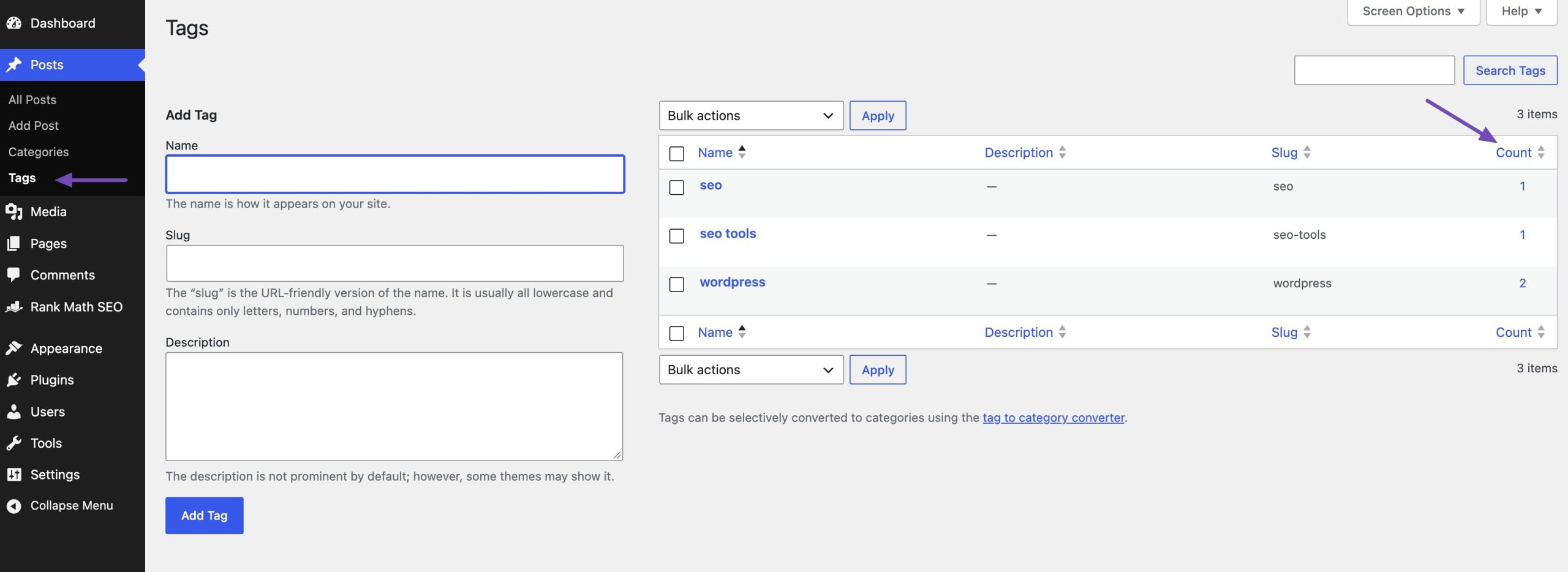
Merge or delete duplicates. Mix near-identical tags equivalent to “Search engine optimization tip” and “Search engine optimization ideas,” then redirect the eliminated tag URL to the one you retain. Rank Math’s Redirections module can deal with this.
Set a tagging rule. Resolve on a brief record of authorised tags and keep away from creating new ones on the fly.
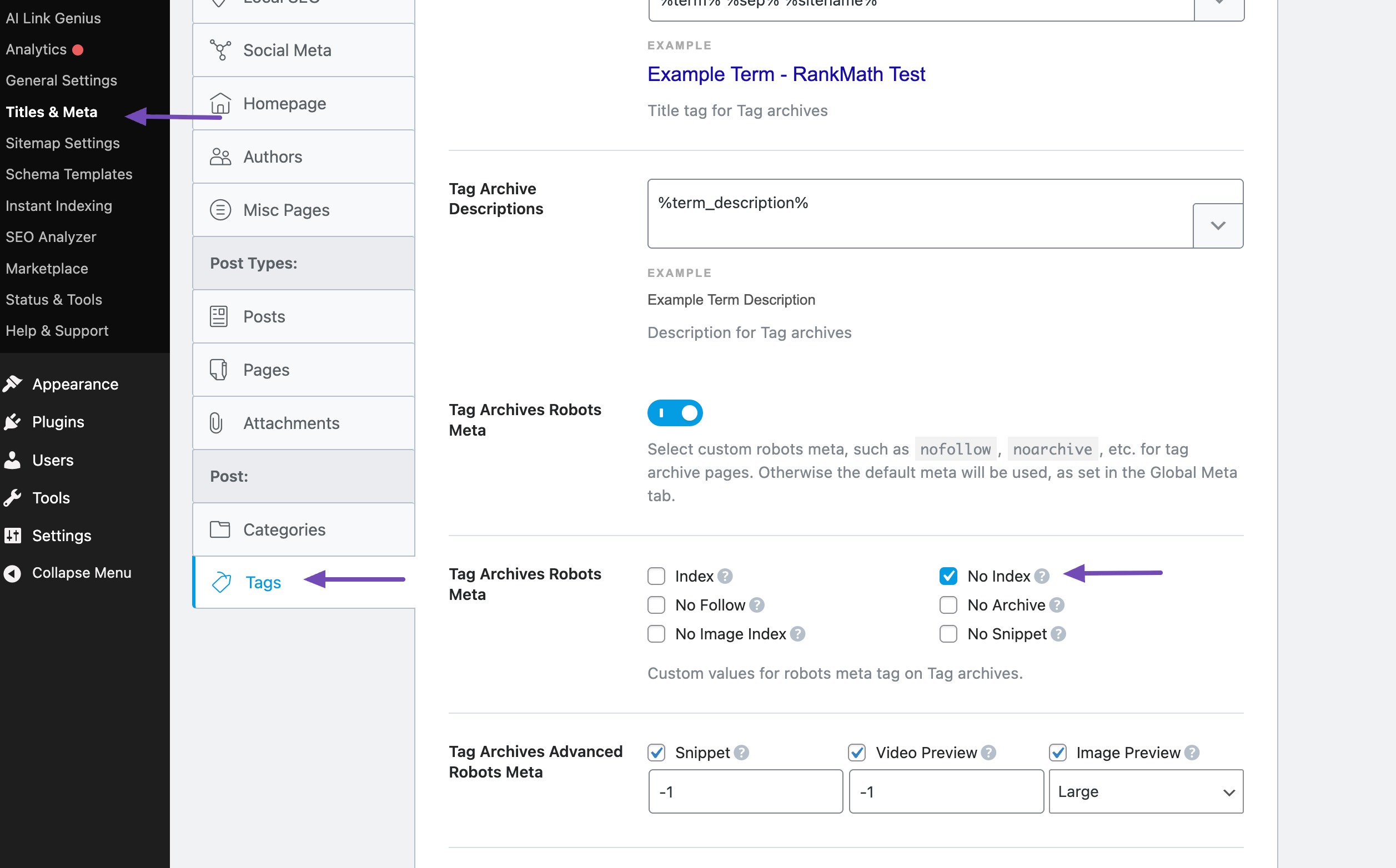
Noindex tags globally. Go to Rank Math Search engine optimization → Titles & Meta → Tags and set the robots meta to noindex for tag archives.
Promote solely your greatest tags. If a tag has many posts and search demand, override the noindex on that tag’s edit display and provides it a singular description, identical to a class web page.
This strategy works as a result of it retains the navigation advantage of tags for readers, whereas eradicating the low-value archives from search outcomes.
6 Widespread Class and Tag Errors to Keep away from
Widespread class and tag errors are setup habits that create skinny, duplicate, or complicated archive pages. Most of them are simple to repair as soon as you understand what to search for.
- Deleting classes with out redirects: Eliminated archive URLs return 404 errors and lose any hyperlinks pointing to them, so at all times redirect them to the closest related class.
- Utilizing the identical phrase as a class and a tag: A class known as “Search engine optimization” and a tag known as “Search engine optimization” create two archives with practically similar posts, which forces Google to decide on between them.
- Leaving “Uncategorized” listed: It alerts an unfinished web site and barely incorporates a coherent subject.
- Creating a brand new tag for each put up: This produces a whole bunch of one-post archives with no distinctive worth.
- Indexing tags however leaving them out of the sitemap (or the reverse): Your robots meta and sitemap settings ought to at all times agree.
- Skipping class descriptions: With out distinctive content material, even a big class web page seems like a reproduction of your weblog homepage.
7 Often Requested Questions
Ought to I noindex WordPress tag pages?
Sure, most WordPress websites ought to noindex tag pages as a result of they are typically skinny and overlap with class pages. The exception is a small set of curated tags with many posts and a singular description, which might be listed individually in Rank Math from the tag’s edit display.
Do class pages assist Search engine optimization?
Sure, class pages assist Search engine optimization once they have distinctive content material, a customized Search engine optimization title, and sufficient posts to cowl a subject in depth. In that case, a class web page can rank for broad key phrases and go inside hyperlink worth to the posts it incorporates.
What number of classes ought to a WordPress weblog have?
Most WordPress blogs work greatest with 5 to 10 top-level classes. That vary is massive sufficient to separate your most important subjects, however sufficiently small that every class archive has sufficient posts to be helpful.
Can a put up be in multiple class?
Sure, a WordPress put up can belong to a number of classes, however assigning one major class is healthier for Search engine optimization.
8 Conclusion
Optimizing WordPress class and tag pages will help enhance your web site’s Search engine optimization and make it simpler for guests to seek out related content material.
Begin by organizing your classes, including distinctive descriptions, optimizing Search engine optimization titles and meta descriptions, and bettering inside linking. For tag pages, deal with retaining solely helpful, well-organized pages listed to keep away from pointless or duplicate content material.
You should use Rank Math to optimize class and tag pages, handle their indexing settings, and enhance their visibility in search outcomes.
Take a while to evaluation your current classes and tags, take away pointless ones, and ensure every web page serves a transparent function.
Choose your prime three classes at present, write an outline for every, and watch them begin working as touchdown pages.
In the event you like this put up, tell us by tweeting @rankmathseo.